


Why the “hidden” muscles are so crucial for erection
The network of the entire pelvic floor muscles is hidden inside the body, unlike for example the biceps or other muscles, and is not directly visible from the outside. About one-third of the penis is also located inside the body. There, the penis is anchored by two central muscles: the musculus ischiocavernosus and the musculus bulbospongiosus. These muscles – often referred to as “potency muscles” – ensure that blood is retained in the erectile tissue. A strong pelvic floor supports a stable and longer-lasting erection, while weak muscles make this significantly more difficult.
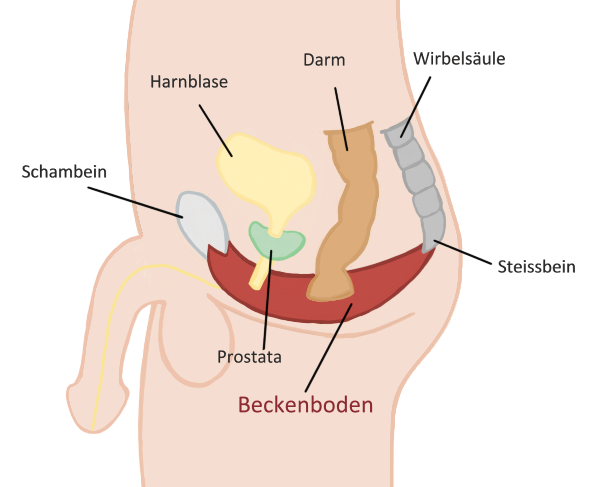
Pelvic floor training for men can therefore help to increase sexual performance and desire – provided there are no organic causes such as vascular or nerve damage. In cases of functional disorders in the pelvic area, therapeutic guidance is recommended – ideally following a prior urological examination by a specialist. A combination of professional pelvic floor rehabilitation and regularly performed self-training leads to noticeable improvements in many cases.
Several scientific studies confirm the positive effects of pelvic floor training on male potency – especially in cases of erectile dysfunction and premature ejaculation. The results show that targeted pelvic floor training improves both blood flow and muscle control in the intimate area [1]
Pelvic floor training for men – simple and effective
Men can train their pelvic floor – with little effort. Whether with Kegel exercises, in physiotherapy, in groups, or at home: Pelvic floor training is an effective, natural, and side-effect-free method to support potency. For men who want to actively train their pelvic floor, the app-supported pelvic floor trainer PelvicTool Home & Sport offers a practical solution for training at home. The application is discreet, intuitive, and possible without a probe – conveniently in normal training clothes.
You are currently viewing a placeholder content from YouTube. To access the actual content, click the button below. Please note that doing so will share data with third-party providers.
Just two to three sessions of five minutes per week can noticeably contribute to strengthening and improving control of the pelvic floor muscles. However, consistency is key: Only with frequent and regular training will the muscles remain elastic, strong, enduring, and functional – with positive effects on potency, continence, and overall well-being.
The PelvicTool by Alonea works with a biofeedback sensor that detects even the smallest muscle movements and transmits them in real time to the corresponding app. This sensor tube rests in the perineum area, i.e., between the anus and the base of the penis. Here, the important sphincter muscles and the “potency muscles” run just beneath the skin. When you contract these muscles, they shorten, thicken, and generate pressure – this is the exact pressure the PelvicTool measures and displays in real time. This allows the movement of the “potency muscles” to be visualized and specifically trained with guidance from the app. The PelvicTool Home & Sport offers varied programs to help users learn how to consciously activate and control the muscles in the perineal area – to support erectile function, bladder control, and bowel regulation.
Conclusion: Pelvic floor training pays off – for potency, health, and quality of life.
[1] Source: ↩ Back
- Dorey G, Speakman MJ, Feneley RC, Swinkels A, Dunn CD. Pelvic floor exercises for erectile dysfunction. BJU Int. 2005 Sep;96(4):595-7. doi: 10.1111/j.1464-410X.2005.05690.x. PMID:16104916
- Dorey G, Speakman M, Feneley R, Swinkels A, Dunn C, Ewings P. Randomised controlled trial of pelvic floor muscle exercises and manometric biofeedback for erectile dysfunction. Br J Gen Pract. 2004 Nov;54(508):819-25. PMID:15527607
- de Lira GHS, Fornari A, Cardoso LF, Aranchipe M, Kretiska C, Rhoden EL. Effects of perioperative pelvic floor muscle training on early recovery of urinary continence and erectile function in men undergoing radical prostatectomy: a randomized clinical trial. Int Braz J Urol. 2019 Nov-Dec;45(6):1196-1203. doi: 10.1590/S1677-5538.IBJU.2019.0238. PMID:31808408
- Prota C, Gomes CM, Ribeiro LH, de Bessa J Jr, Nakano E, Dall’Oglio M, Bruschini H, Srougi M. Early postoperative pelvic-floor biofeedback improves erectile function in men undergoing radical prostatectomy: a prospective, randomized, controlled trial. Int J Impot Res. 2012 Sep;24(5):174-8. doi: 10.1038/ijir.2012.11. Epub 2012 May 10. PMID:22573231
